Travel Suitcase with Camera Illustration: Graphics & Illustrations
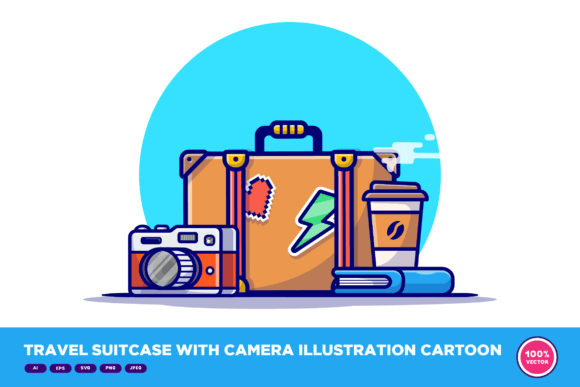
As someone who’s launched over 200 digital products across Etsy, Creative Market, and Shopify—and scaled a print-on-demand brand to six figures—I opened Travel Suitcase with Camera Illustration expecting charm, but what stood out was its quiet versatility. It’s a flat cartoon-style vector illustration featuring a suitcase, vintage-style camera, open book, and steaming coffee cup—all arranged in a balanced, isolated composition. There’s no clutter, no forced whimsy—just clean lines, friendly proportions, and a warm, approachable holiday-business mood. It leans gently into travel, creativity, and slow-living aesthetics without tipping into kitsch or overused tropes.
This isn’t a bold, high-contrast icon for tech startups or a moody minimalist piece for luxury brands. Instead, it speaks directly to makers: the Etsy seller launching a “Wander & Write” planner bundle, the Canva template creator building a summer newsletter suite, or the Cricut user designing luggage tags and travel journals. Its personality is thoughtful, slightly nostalgic, and quietly confident—ideal for audiences who value authenticity over flash. Think small business branding for boutique travel agencies, handmade stationery shops, or indie podcasters covering storytelling and adventure.
In real product-building scenarios, Travel Suitcase with Camera Illustration earns its keep across multiple formats. As an SVG design, it cuts cleanly on Cricut and Silhouette machines—perfect for vinyl decals on tumblers, tote bags, or luggage tags. As a PNG design with transparent background, it scales beautifully for printable wall art, planner stickers, greeting cards, and social media graphics. I tested it in a sublimation mockup for ceramic mugs and it held detail at 300 DPI without pixelation. It also works well as part of a larger clipart set—paired with passport stamps, airplane silhouettes, or mountain outlines—to build themed design bundles for Creative Fabrica or Design Bundles.
Where this graphic design asset truly shines is in visual storytelling for listings. On Etsy, I dropped it into three different mockups: a soft linen notebook cover, a matte-finish travel journal thumbnail, and a lifestyle flat lay with coffee and sunglasses. In every case, it added instant context and emotional resonance—no extra copy needed. Buyers scanning quickly understood the theme, tone, and use case. That’s rare. Most illustrations either feel generic or overly specific; this one lands right in the middle, supporting brand consistency without limiting interpretation.
For digital product creators, it slots naturally into Canva templates—especially invitation suites for destination weddings, workshop workbooks for travel photographers, or blog graphics for location-independent entrepreneurs. As a t-shirt design, it reads clearly even at 8-inch width on a unisex tee. As a mug design, it balances well beside a short quote like “Collect Moments, Not Things.” And because it’s built with generous negative space and distinct shapes, it adapts easily to nursery prints, scrapbooking kits, and digital paper packs without competing with patterns or text.
That said, there are places where Travel Suitcase with Camera Illustration needs careful handling. Don’t force it into tiny sticker sheets under 0.5 inches—the coffee steam and camera lens details soften at micro-scale. Avoid placing it over busy backgrounds or low-contrast textures; its warmth relies on clear separation. In text-heavy Canva templates (like multi-page contracts or dense resource guides), it works best as a subtle header accent—not a central visual anchor. And if you’re using it for Cricut projects requiring intricate weeding (e.g., layered iron-on transfers), double-check the SVG paths: some versions group elements tightly, which may require manual ungrouping before cutting.
Before publishing any product, here’s how I test assets like this: First, I drop the PNG into a real marketplace thumbnail (1200×1200 px) alongside my shop’s font pairings—serif for elegance, sans serif for clarity, script for personal touch—and see what feels cohesive. Second, I preview it on both white and dark mockups to confirm contrast and legibility. Third, I run a quick print test: 4×6 inch on matte photo paper, then on kraft cardstock, checking color fidelity and edge sharpness. Fourth, I open the SVG in Cricut Design Space and simulate a cut—verifying no stray nodes or overlapping paths. Finally, I scan the license: this is a commercial design, yes—but only if used in finished products (not resold as standalone vectors). Always verify that with the original seller.
Organization matters just as much as execution. When bundling Travel Suitcase with Camera Illustration into a digital download, label files clearly: “suitcase-camera-book-coffee-flat-cartoon-illustration.svg”, “...-300dpi-png.png”, “...-black-bg-version.png”. Include a simple PDF guide showing recommended fonts—Lora for serif, Inter for sans, Qwigley for script—and a few layout examples (e.g., “Use with 12-pt spacing for planner stickers”). That small step boosts perceived value and reduces customer support requests.
This illustration won’t replace your entire creative toolkit—but it fills a precise, profitable gap. It’s not flashy, but it’s reliable. Not trendy, but evergreen. Not complex, but full of quiet intention. For sellers building seasonal collections (think “Summer Launch Kits” or “Back-to-Work Travel Planners”), it adds cohesion without demanding attention. For print-on-demand shops, it’s a low-risk, high-context addition to existing product lines. And for digital product creators juggling dozens of assets, it’s one less thing to overthink—because it simply works.
If you’re evaluating Travel Suitcase with Camera Illustration for your next Etsy product, Canva template, or Cricut project: trust your first impression, test it in context, and prioritize clarity over cleverness. In the long game of creative selling, consistency, usability, and quiet confidence beat viral hype every time.